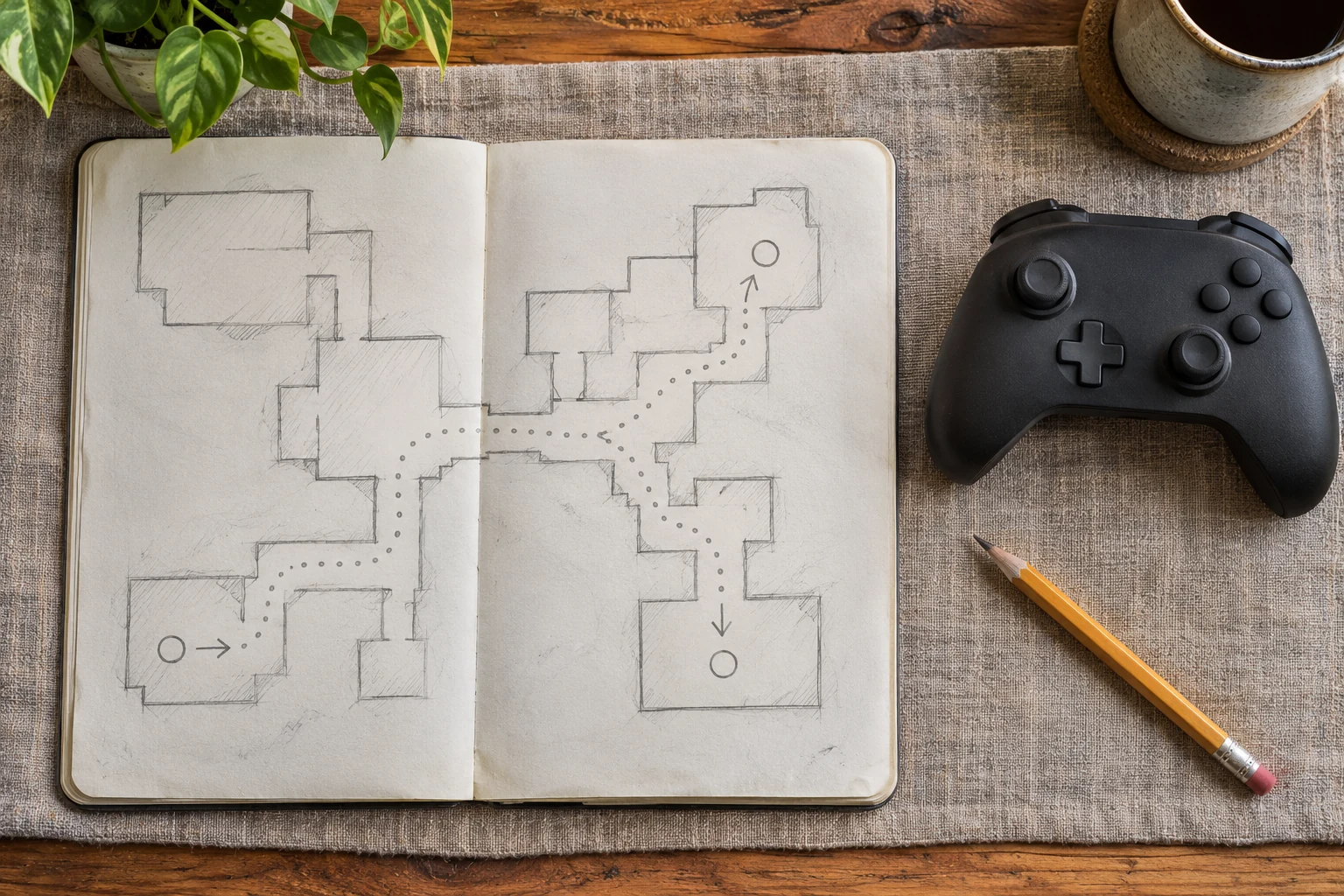
Stuck at a locked door? The game may be waiting for a conversation you skipped, not another key. A useful walkthrough names the missing trigger and the next action, then stops. You shouldn’t have to read about the final boss to get out of one room.
Choose the smallest answer that gets play moving: a hint for the next step, an exact sequence for a tricky section, or a complete route when you want every objective.
Which walkthrough fits the problem?
| Stuck on | Best type of help | What to verify |
|---|---|---|
| Where to go next | Main quest or chapter walkthrough | Current mission, prerequisite and checkpoint |
| A difficult enemy | Boss strategy or encounter breakdown | Attack phases, openings, gear and difficulty |
| A door, code or riddle | Puzzle hint followed by a solution if needed | Clues, item requirements and puzzle setting |
| A missing item or location | Interactive map or collectible route | Region, map layer, coordinates and access conditions |
| A branching choice | NPC questline or ending requirements | Point of no return, dialogue conditions and consequences |
| Platinum, Gamerscore or 100% | Trophy and achievement roadmap | Missables, playthrough count, DLC and clean-up options |
If the credits are your target, start with the main quest. Already finished the story? A collectible checklist won’t make you trawl past late-game cutscenes.
Check the game state before following a step
Match the guide to your save before retracing steps:
- Exact game and edition: distinguish the original, remaster, remake and any definitive edition. Maps, controls and item locations can change.
- Platform and input: PC keyboard and mouse, PlayStation, Xbox, Nintendo Switch, Switch 2 and mobile interfaces do not always share button prompts or menu layouts.
- Quest and checkpoint: check the journal, active objective, chapter name, area and latest unlocked fast-travel point.
- Required items and abilities: inspect key items, equipped skills, spells, tools, party members and crafting materials before retracing a route.
- Game version: compare the guide's update date with a major patch, expansion, season or balance change, particularly for live-service games.
Save before a one-way transition or a dialogue choice with lasting consequences, if manual saving is available. A “100%” label doesn’t mean every reward is still obtainable in your current playthrough.
Main story and quest walkthroughs
A story walkthrough works best in unlock order: prerequisite → location → interaction → encounter → new objective. Straight-line routes across an open-world map fail when the marker won’t appear until you speak to an NPC or finish the earlier quest.
Open-world routes, dungeons and optional paths
In The Legend of Zelda: Tears of the Kingdom, the Wind, Fire, Water and Lightning Temples need step-by-step routes; Shrines and Korok Seeds need tracking. Hyrule has three map layers—Sky, Surface and Depths. A Lightroot marker on the Depths layer won’t help if you’re searching the Surface.
An Elden Ring map route through Limgrave, Stormveil Castle or the Academy of Raya Lucaria won’t tell you when Ranni’s NPC quest advances. Sites of Grace make good checkpoints. Dialogue triggers and ending conditions don’t always follow boss order, so check the quest stage before entering an optional area.
In Prince of Persia: The Lost Crown, a route through Mount Qaf may stay blocked until you unlock a Time Power. Return after acquiring a movement ability. Amulets and Athra Surges change combat options; side quests and secrets sit off the main path.
Multiple storylines and branching objectives
Paldea doesn’t have a single mandatory route. Pokémon Scarlet and Violet lets players move between Victory Road, Path of Legends and Starfall Street. Gym Leaders, Titan Pokémon and Team Star bases belong to different story threads; Pokédex entries, evolutions and post-game activities need separate tracking.
In dialogue-heavy RPGs, a choice can affect a companion or faction long after the quest reward appears. Check whether a response changes later quests before selecting it.
Boss walkthroughs: learn the pattern, then change the plan
If the boss keeps killing you at the same moment, stop practising the opening and study that move. Find its tell, test the safe dodge direction, then watch for the recovery window.
- Read the arena: locate cover, hazards, edges, environmental tools and any interactable objects before committing resources.
- Learn one attack at a time: recognise audio cues, wind-up animations, combo finishers and area-of-effect markers.
- Check your build: weapon upgrades, armour, resistances, healing items, consumables and abilities can matter more than another level.
- Respect stamina and cooldowns: leave enough capacity to dodge, block, parry or escape after attacking.
- Adjust at the phase change: a new enemy, shield, status effect or damage window may replace the strategy that worked at the start.
A Soulslike boss guide should explain timing, not just the recommended weapon. In Monster Hunter Wilds, a hunt also depends on monster behaviour, gear upgrades, materials and Hunter Rank. Destiny 2 raids may require assigned roles and symbol callouts before a damage phase; a solo build won’t solve teamwork mechanics.
Combat difficulty changes damage and healing windows. Boss tells and positioning still apply; the guide’s timing or resource estimates may not.
Puzzle solutions without unnecessary spoilers
For a riddle, start with the clue rather than the answer. Find the right room, identify the objects you can manipulate and check what the game has already logged. A single screenshot can settle a spatial puzzle faster than a long video.
In Silent Hill 2 Remake, puzzles in Wood Side Apartments and Brookhaven Hospital involve memos, keys and combinations. Their answers can differ between Light, Standard and Hard puzzle settings. Combat difficulty is separate; a code copied from another puzzle setting can fail on an otherwise identical save.
A code that doesn’t work isn’t necessarily wrong. You may need to examine a clue or use an object first. Some games randomise combinations between runs; knowing the method beats copying a number.
Interactive maps, collectibles and hidden rewards
A map pin doesn’t show the path to a chest behind a locked door or a Korok above a cave.
Filter a crowded map by region and objective before counting pins. Shrines, fast-travel points, chests, upgrades and quests are easier to track separately. Coordinates won’t tell you that a reward is underground or behind an ability gate.
Track collectibles as collected, visible but inaccessible or missed. Record the condition for each inaccessible reward, so you know when to return.
Game terms matter when searching: Tears of the Kingdom uses Shrines, Korok Seeds and Lightroots; Donkey Kong Bananza has Banandium Gems and Fossils; Silent Hill 2 Remake lists Memos, Strange Photos and Glimpses of the Past. An exact item name finds a narrower result than “all secrets”.

A spoiler-safe way to get unstuck
- Confirm the objective. Read the quest log and inspect the map for the correct region, chapter or marker.
- Find the missing condition. Look up the mission name as it appears in your journal, together with “prerequisite”, “key item” or “NPC location”.
- Reveal one step. Read only until the next interaction, then resume playing. Avoid scrolling into the following boss or cutscene.
- Use the full sequence if needed. A numbered walkthrough or chapter-specific video can settle a complex route when isolated hints do not.
For bosses, include the phase or attack name. For a puzzle, try “hint” before “solution”.
100% completion, trophies and achievements
Campaign credits, an in-game 100% tracker and platform achievements aren’t interchangeable. A PlayStation Platinum trophy, Xbox Gamerscore, Steam achievements and DLC lists can demand different tasks. Look at the missable requirements before starting a completion run.
Plan the run in three passes
- Before the campaign: identify missable trophies, mutually exclusive endings, required difficulty, online-only tasks and areas that cannot be revisited. Check whether Chapter Select, manual saves or New Game+ actually exist.
- During the story: collect time-sensitive items in chronological order, advance NPC quests before their cut-off points and maintain a simple checklist. Do not rely on memory across a long RPG.
- After the credits: use a region-by-region clean-up route for remaining collectibles, side activities and upgrades only where the game permits post-game free roam or chapter replay.
Hell is Us collectible guidance warns about missables and, for the version covered, no Chapter Select or New Game+. A missed item in that setup may require another playthrough.
Roadmaps from PowerPyx and TrueAchievements track more than story progress: offline and online requirements, missable achievements, estimated difficulty and playthrough count. Treat completion times as estimates, particularly when DLC or patches change requirements.
When the walkthrough does not match your game
An absent NPC doesn’t always mean the save is broken.
- Quest trigger: revisit the journal, required conversation, prior boss or completed side objective.
- Location and time: verify the floor, entrance, map layer, day-night cycle and fast-travel destination.
- Inventory and abilities: check whether the item must be equipped, handed to an NPC, crafted or used at a specific object.
- Mode and version: compare single-player with co-op, Standard with Hard, the base game with DLC, and your current patch with the guide's date.
- Save state: reload a recent save or return to a safe checkpoint only after ruling out unfinished prerequisites. Preserve an older save before experimenting with irreversible choices.
Screenshots can become obsolete after patches. If an item has moved or its reward no longer appears, compare the in-game objective with official patch notes and another maintained guide. Seasonal events and balance changes are especially prone to outdated instructions.
Text walkthrough, video guide, wiki or interactive map?
Text walkthroughs work well when you need an exact objective, key item or dialogue condition: search the page for the quest name and stop at the right step. GameFAQs and Neoseeker can also have coverage for older games that never received detailed video guides.
Video walkthroughs show precise jumps, boss timing and spatial puzzles. Use chapter timestamps where available, and check the game version.
Community guides and wikis are good for following relationships: an NPC leads to a quest, the quest needs an item, the item drops from an enemy. Steam Guides combine screenshots and written steps with videos. Community comments may flag a patch-related error, though a high rating isn’t proof.
Interactive maps suit exploration and farming. They won’t explain quest dialogue or a dungeon’s switch order; add a short step sequence for progression-locked items.
Walkthrough routes for different games
- The Legend of Zelda: Tears of the Kingdom: temple routes and layered-map searches.
- Elden Ring: NPC quest conditions and route planning.
- Pokémon Scarlet and Violet: separate story threads and completion tracking.
- Silent Hill 2 Remake: puzzle-setting checks and encounter routes.
- Prince of Persia: The Lost Crown: ability-gated Mount Qaf routes.
Subnautica walkthroughs lean on blueprints, resources and oxygen rather than chapter numbers. In an extraction shooter such as ARC Raiders, the route out is as relevant as the quest item. Roguelikes need explanations of builds and mechanics because a room sequence may change from run to run.
Walkthroughs for gamers in New Zealand
A walkthrough written for North America may describe the right quest yet cite a release date that doesn’t match a New Zealand storefront. Check the edition and DLC availability on the local PlayStation Store, Xbox Store, Nintendo eShop or Steam before following an early-access or expansion route.
Live-event schedules may use UTC or US time. New Zealand switches between NZST and NZDT, so an event dated Friday overseas could begin on Saturday locally. Use the official event time, not a countdown copied into an old guide.
Remapped controls, accessibility settings, PC mods or another controller layout can change button prompts without changing the objective.
Walkthrough questions players run into
Does a full walkthrough always include side quests?
No. “Full” may cover only the main campaign. Side quests, collectibles, alternate endings and DLC may be handled separately.
Can I follow a 100% guide after finishing the story?
Only when missed items can still be reached. One-way areas, time-sensitive quests and mutually exclusive endings may force another run; Chapter Select or New Game+ can change that.
What if a boss strategy is not working?
Watch the attack that ends your attempts. Check its tell, the safe dodge or block, and the recovery window. Then check gear and role assignments if you’re playing co-op.
Why is a puzzle code different from the one in a guide?
The puzzle setting may differ, or the game may randomise the answer. Check the clue and difficulty before copying a code.
Are text walkthroughs better than videos?
Neither universally. Text suits exact quest steps; video helps with movement and boss timing. Use an interactive map when the problem is finding an object rather than completing a sequence.