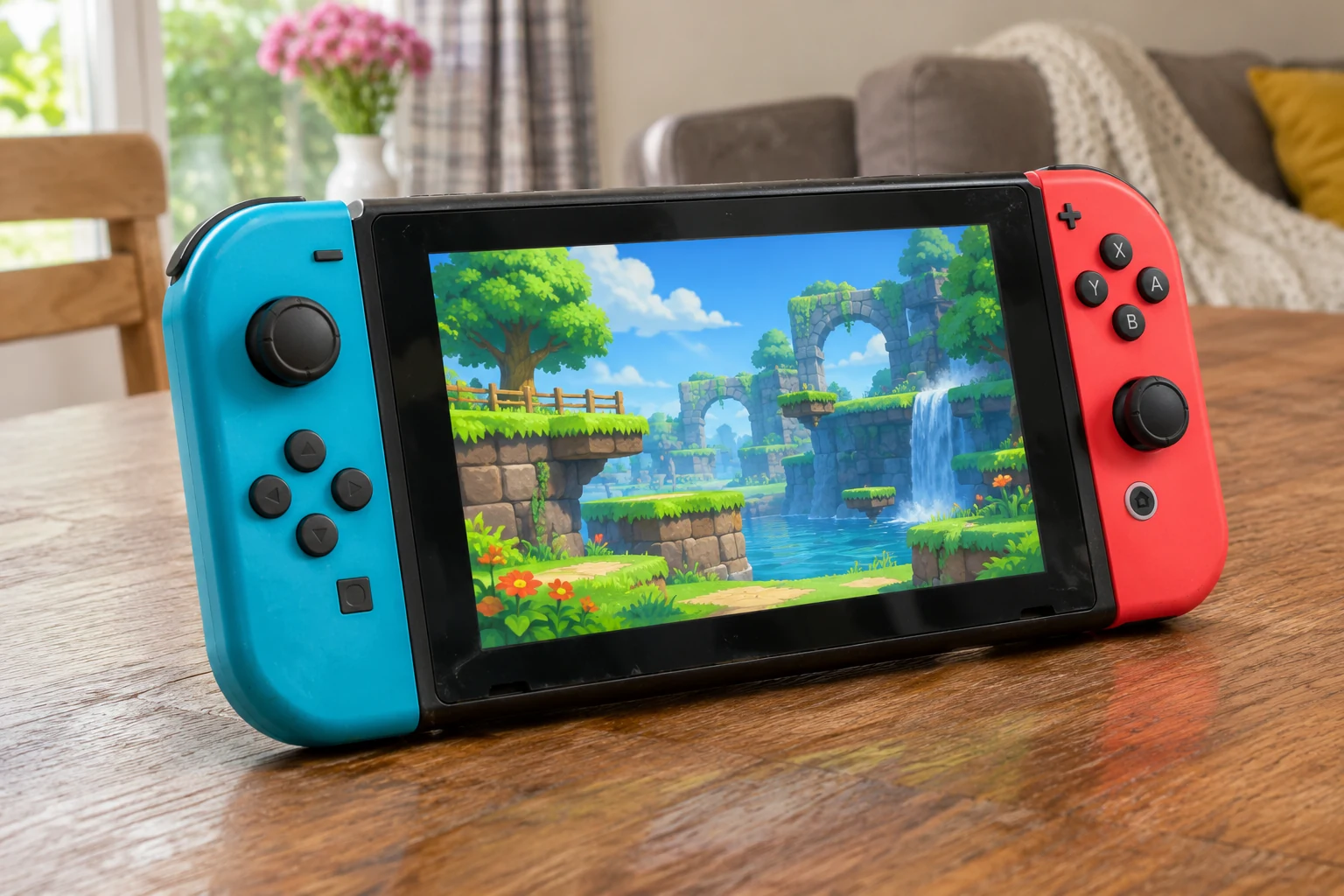
A glowing review for a Nintendo game will not tell you whether four people can play on one screen. Nor will it tell a solo player whether a game is built around puzzles, battles or collecting. Switch 2 has added exclusives alongside enhanced versions of older favourites; for New Zealand households, choosing the right game now also means checking the edition, the controllers and the way multiplayer works.
Which Nintendo game fits your play style?
| Game | Best fit | Main trade-off | Console |
|---|---|---|---|
| Mario Kart World | Racing nights, families and online competition | Free Roam lacks the urgency of its races | Switch 2 only |
| Donkey Kong Bananza | Creative 3D platforming and collectible hunting | Busy scenes and a restless camera can interrupt play | Switch 2 only |
| The Legend of Zelda: Ocarina of Time (2026) | Dungeon puzzles, story and a defined quest | Its older progression structure remains demanding | Switch 2 only |
| The Legend of Zelda: Tears of the Kingdom | Open-ended exploration and building solutions | Its huge world requires patience and self-direction | Switch; enhanced Switch 2 Edition |
| Pokémon Pokopia | Relaxed crafting, habitats and long-term projects | Little appeal for battle-focused Pokémon fans | Switch 2 only |
| Pokémon Legends: Z-A | Real-time Pokémon battles and team-building | Its urban setting is less varied than a wilderness journey | Switch; enhanced Switch 2 Edition |
| Metroid Prime 4: Beyond | Solo sci-fi exploration, combat and scanning puzzles | Guided sections can interrupt the feeling of isolation | Switch; enhanced Switch 2 Edition |
| Splatoon Raiders | Co-operative shooting, loot and progression | Repetitive loops; no same-screen co-op | Switch 2 only |
| Super Mario Bros. Wonder | Accessible, inventive side-scrolling platforming | Bellabel Park's extra modes favour group play | Switch; expanded Switch 2 Edition |
Mario Kart World: the better the race, the less Free Roam matters
Mario Kart World links its courses with open roads and supports fields of up to 24 online racers. Knockout Tour is the standout: drivers below the cut at each checkpoint are eliminated. Position matters, but so does saving an item for the next stretch. Grand Prix and VS Race retain the quick rematches familiar from Mario Kart 8 Deluxe.
Rail-grinding and wall-riding bring a little more skill to familiar drifting. A blue shell can still ruin a comfortable lead. Mario, Luigi, Peach, Yoshi and Bowser are back amid the chaos.
Free Roam is where opinions split. Driving between locations and hunting discoveries is pleasant enough, but the world has little of Knockout Tour's pressure. The racing can be outstanding without the open-ended driving being especially absorbing.
Four people can race on one Switch 2, provided the household has enough controllers. Online competition needs internet access and the relevant Nintendo Switch Online membership. If Mario Kart 8 Deluxe already fills your evenings, the reasons to move on are Knockout Tour, bigger courses and the new handling, not merely the existence of an open world.
Donkey Kong Bananza: exploration through destruction
In Donkey Kong Bananza, the level is something to tear apart. Donkey Kong punches through walls, digs into buried rooms and rips up terrain to find new routes, fossils and collectibles. A solid-looking barrier might conceal a shortcut or an entire challenge.
Pauline's singing triggers Bananza transformations: Kong delivers heavier blows, Zebra races across fragile ground and Ostrich opens aerial routes. The forms change what DK can reach. Banandium Gems, outfits and fossils reward detours; Void Company (VoidCo) provides the opposition.
When DK levels a room, the camera does not always keep up. There are also performance dips in busy sequences. For players who love finding their own way through destructible terrain, those are interruptions. For anyone who wants cleanly framed jumps, they are harder to ignore.
Bananza suits collectors who enjoy testing routes. Players after precise jumps and tightly authored stages may prefer Super Mario Odyssey or Super Mario Bros. Wonder. Assist Mode eases the challenge, while a second player helps as Pauline. It's an asymmetric role, not two equally capable adventurers. As a native Switch 2 exclusive, Donkey Kong Bananza showcases environmental destruction rather than an older Switch game running at higher resolution.
The Legend of Zelda: three ways to experience Hyrule
Ocarina of Time: defined dungeons and meaningful clues
Released in November 2026, the remake of The Legend of Zelda: Ocarina of Time rebuilds Hyrule with new visuals, orchestral music, expanded dialogue, voiced cutscenes and modern camera controls. Navi guides Link between childhood and adulthood as Princess Zelda, Ganondorf and the Triforce shape the quest.
Dungeon design remains its hook. Clues point to tools: the slingshot, boomerang, hookshot and bombs each open routes as well as help in combat. Even the Water Temple demands a mental map of several connected spaces. This adventure expects you to work things out.
Ocarina of Time moves at a deliberate pace: clues lead to equipment, and equipment opens the next dungeon. Tears of the Kingdom leaves much more room to improvise. The remake preserves the 1998 quest while updating controls and presentation. It is a standalone Switch 2 release, not the emulated Nintendo 64 version in Nintendo's classic-game service.
Breath of the Wild and Tears of the Kingdom: freedom has a cost
The Legend of Zelda: Breath of the Wild opens Hyrule to climbing, survival and discovery. Tears of the Kingdom stretches that freedom across sky islands and the Depths, with Zonai devices and powers such as Ultrahand, Fuse, Ascend and Recall. Why follow a path when you can build a bridge or vehicle?
Freedom also brings detours, inventory management and long stretches without a scripted objective. Players who want a sequence of tightly connected dungeons may prefer Ocarina of Time. Those drawn to shrines, physics puzzles and choosing their own destination will feel at home in the open-world games.
Both Zelda adventures have Nintendo Switch 2 Editions with improved resolution, frame rates and loading times, plus ZELDA NOTES companion features. Existing owners can buy upgrade packs; eligible Nintendo Switch Online + Expansion Pack subscribers can use those upgrades while their membership remains active.
Pokémon Pokopia versus Pokémon Legends: Z-A
Pokopia: habitats rather than gym battles
Ditto takes a human-like form in Pokémon Pokopia and helps revive an abandoned landscape. Professor Tangrowth and other Pokémon contribute to habitats, crops, furniture and a growing settlement. Bulbasaur's Leafage restores vegetation; Lapras's Surf opens waterways. Pikachu and other familiar species settle into the spaces you build. It's habitat planning rather than a hunt for gym badges.
Days and weather change in real time, with decorating, gathering and small requests waiting between visits. Fans of Animal Crossing: New Horizons will recognise that unhurried structure. There is no standard gym-battle campaign, so players who care more about type match-ups than building habitats may lose interest.
Friends can build together through supported local wireless or online modes, and eligible guests can join through GameShare without every player owning the game. Check the connection rules before arranging a session. Pokopia runs on Switch 2, not the original Switch.
Legends: Z-A: fast decisions in Lumiose City
Pokémon Legends: Z-A takes place in Lumiose City, in the Kalos region. Battles unfold in real time: positioning, movement, attack timing and Mega Evolution matter alongside the team you bring. The nightly Z-A Royale gives those encounters a competitive goal, while catching Pokémon and building a balanced team remain central.
Lumiose City's repeated streets are less varied than the wilderness of Pokémon Legends: Arceus. The compact setting favours learning the combat over roaming broad landscapes. Legends: Z-A works on the original Switch; its Switch 2 Edition improves resolution and frame rate rather than adding a new storyline.
Metroid Prime 4: Beyond: atmosphere before spectacle
Developed by Retro Studios, Metroid Prime 4: Beyond sends Samus Aran to Viewros. Exploration follows a familiar rhythm: scan a room, find clues, unlock equipment, defeat bosses and revisit areas once inaccessible. The Scan Visor turns the environment into part of the puzzle, not just scenery.
Sol Valley changes the pace with journeys on the Vi-O-La motorcycle; Galactic Federation companions interrupt Samus's usual solitude. Reviewers are split on both ideas. An isolated scan-and-explore experience has a different appeal from one punctuated by travelling and conversations.
On Switch 2, Joy-Con 2 mouse aiming joins Quality and Performance modes. On suitable televisions, Quality Mode targets 4K at 60 frames per second and Performance Mode up to 120 frames per second at 1080p. The latter needs a 120Hz display. Both affect responsiveness and presentation, not the adventure's pacing. Metroid Prime 4 is made for solo exploration. A first-person view does not make it a replacement for a multiplayer shooter.
Splatoon Raiders: cooperative raids, not another Turf War
Splatoon Raiders sends a mechanic and Deep Cut—Shiver, Frye and Big Man—to the Spirhalite Islands to fight Salmonids and gather loot. Weapons, gadgets and crafting support repeated expeditions. Think raids and upgrades rather than Splatoon 3's fast Turf War matches.
Team play makes the waves livelier, but repeating familiar routes for incremental gear can wear thin, especially alone. Anyone who mainly enjoys competitive ink control in Turf War should expect a different kind of shooter.
One console is not enough for group multiplayer. Splatoon Raiders supports local wireless and online play, but not shared-screen co-op: Nintendo lists one player per Switch 2. Friends need their own systems.
Mario Wonder, Animal Crossing and Kirby: quieter alternatives to the blockbusters
Wonder Flowers turn familiar side-scrolling stages into strange set pieces in Super Mario Bros. Wonder. Mario, Luigi, Peach and Daisy explore the Flower Kingdom with controls that welcome less practised players. The Switch 2 Edition adds Meetup in Bellabel Park, Rosalina, Co-Star Luma, Koopaling challenges and further multiplayer attractions.
Bellabel Park is an easier sell for groups than for someone who finished Wonder alone. Its attractions add variety, not a whole new single-player Mario campaign. The original stages remain the draw.
Animal Crossing: New Horizons runs on a different clock. Fishing, catching bugs, decorating homes and getting to know villagers replace bosses and levels. The Switch 2 Edition supports mouse-assisted decorating, but the real-time routines remain. Pokopia offers similar building satisfaction, with Pokémon abilities giving its projects another twist.
Kirby and the Forgotten Land is a gentler, guided 3D adventure. Its Switch 2 Edition includes the Star-Crossed World expansion. Choose Kirby for authored platforming challenges; Bananza for tearing through the level to make your own route.
Is Nintendo Switch 2 actually necessary?
You do not need Switch 2 for everything. Mario Kart 8 Deluxe, Super Mario Bros. Wonder, Animal Crossing: New Horizons, Breath of the Wild and Tears of the Kingdom all began on Switch. Switch 2 plays many existing physical and digital releases, with some exceptions and update requirements.
Mario Kart World, Donkey Kong Bananza, Pokémon Pokopia, Splatoon Raiders and the 2026 Ocarina of Time remake are Switch 2 exclusives.
Switch 2 has a 7.9-inch 1080p screen, 256GB of storage and Joy-Con 2 controllers that can work as a mouse. A compatible television and game are needed for 4K output. Hardware specifications alone do not settle whether battery life, handheld comfort or the cost of extra controllers will suit your household.
A Nintendo Switch 2 Edition might be a visual update, extra content or a different control scheme. Check which applies before paying for an upgrade pack, particularly if you already finished the original.
What New Zealand buyers should check before paying
Physical card, game-key card or digital download?
A boxed game-key card is not the same as a standard game card. The former authorises an initial download, so you need internet access and free storage; it stays inserted when you play. Once installed, an ongoing connection usually is not required just to launch. Check the logo on the box.
For New Zealand households on limited broadband, download size can outweigh a discount. Switch 2 games use microSD Express cards for expanded game storage; an older standard microSD card will not serve the same purpose.
One console, separate consoles or online?
GameShare lets one owner host compatible games for guests, with a Switch 2 host; online sharing uses GameChat.
Many online modes require Nintendo Switch Online. GameChat needs an eligible membership after its introductory period, while same-console multiplayer usually does not. Check the household cost, including controllers and extra systems, not just the game's price.
Price, ratings and the right edition
Compare NZD prices for the exact edition you need. A boxed copy, Nintendo eShop download, upgrade pack and bundle can have different entitlements. Check platform compatibility, whether the base game is required and which downloadable content is sold separately.
Nintendo's familiar art style is not an age rating. Use the New Zealand classification and content descriptors when choosing for children: Metroid's tension, Zelda's combat and Splatoon's online interaction raise different questions.
How to read Nintendo review scores without buying the wrong game
Ask four questions before trusting a score: What does the player spend most time doing? Can everyone play on the same hardware? Which flaw matters to that player? Does the edition on sale include the praised feature?